
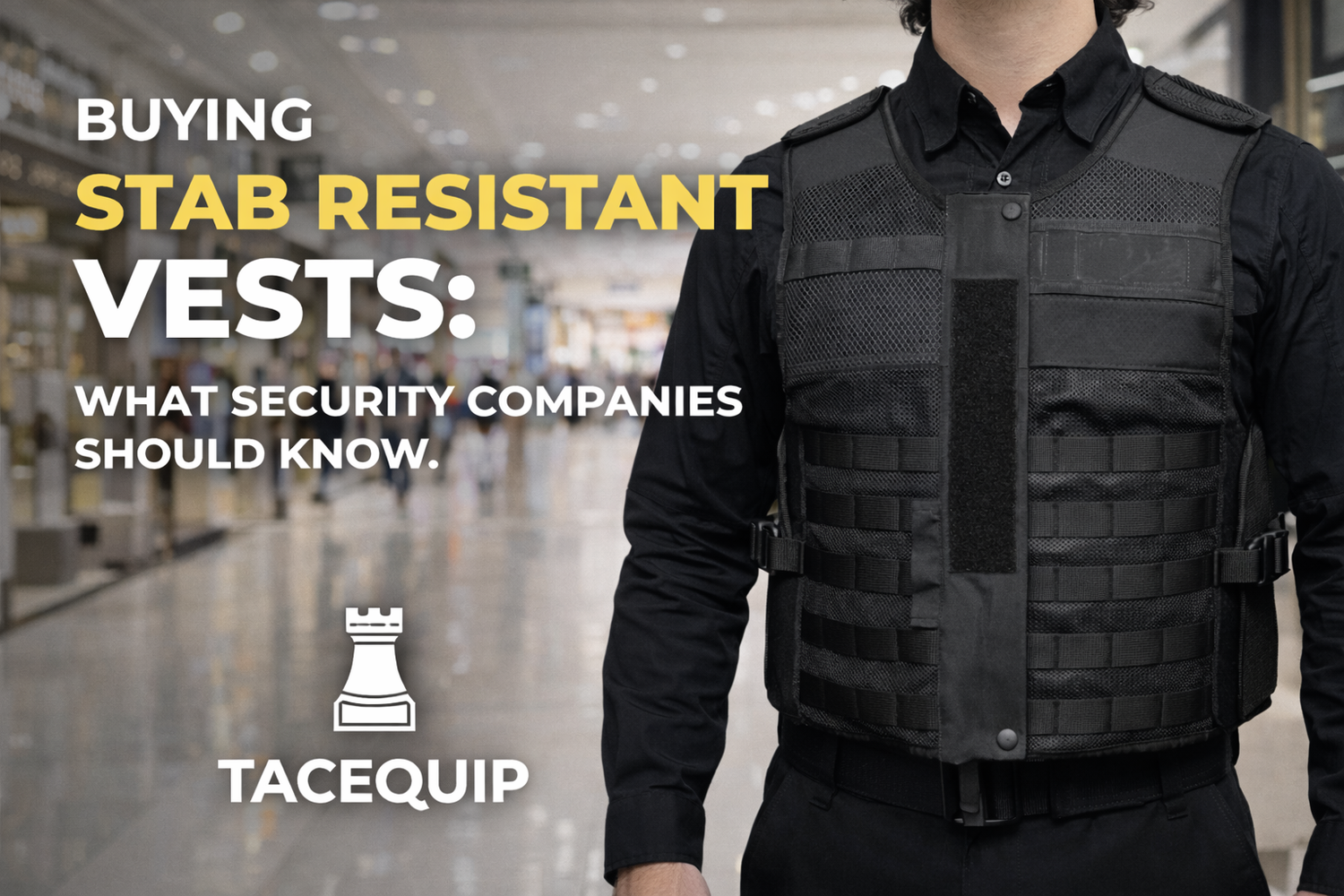
Security operations across Australia and New Zealand face increasing risk exposure in retail, transport, event, and asset protection environments.
Selecting a stab resistant vest is not simply a procurement exercise — it is a compliance, safety, and operational decision that impacts officer wellbeing, insurance exposure, and duty-of-care obligations.
If you are evaluating a security vest supplier in Australia or New Zealand, here is what professional procurement teams should assess before purchasing.
1. Verified Certification Under Recognised Standards
The most critical factor when buying stab resistant vests in Australia or NZ is independent certification.
Security companies should request documented testing under recognised standards such as:
-
NIJ Standard-0115.00 – Stab and spike resistance testing
-
VPAM K2 – European stab protection benchmark
It is important to understand the difference between:
-
Slash resistant fabrics
-
Ballistic (firearm) body armour
These are tested under different methodologies and are not interchangeable.
A legitimate supplier should provide:
-
Independent laboratory reports
-
Threat level data (measured in Joules)
-
Confirmation of test methodology
-
Batch traceability where applicable
If documentation cannot be provided upon request, the product should not be considered for professional deployment.
2. Fit, Comfort & Wearability for Long Shifts
In Australia and NZ, security officers routinely work 8–12 hour shifts in varying climates.
When assessing the best stab vest for security guards, consider:
-
Adjustable shoulder and waist systems
-
Breathable outer carriers suitable for warmer climates
-
Ergonomic panel shaping for seated duties
-
Female-specific sizing options
Key procurement questions:
-
What is the total vest weight (carrier + panels)?
-
Is the panel flexible or rigid?
-
Is there moisture sealing?
-
Are replacement carriers available separately?
If a vest is uncomfortable, officers will adjust it improperly — reducing coverage effectiveness.
3. Panel Construction & Lifecycle Planning
Professional security companies should treat stab vests as controlled safety equipment with defined lifecycles.
Panels should:
-
Be removable for inspection
-
Be sealed against moisture ingress
-
Include anti-spike reinforcement
-
Have a defined service life (commonly up to 5 years depending on manufacturer guidance)
Procurement teams should also confirm:
-
Replacement panel availability
-
Warranty coverage
-
Lead time for future top-up orders
Long-term supply continuity is critical for organisations operating across multiple sites in Australia or New Zealand.
4. Australia & NZ Legal Considerations
Body armour regulation differs between jurisdictions.
In Australia, certain states regulate ballistic body armour differently from stab-resistant equipment. In New Zealand, restrictions primarily focus on firearm-rated armour.
Responsible suppliers should:
-
Verify purchaser identity
-
Confirm business legitimacy
-
Maintain transaction records
-
Refuse sales where risk indicators are present
Professional suppliers do not sell controlled protective equipment directly to unverified individuals.
This due diligence protects both the buyer and supplier from regulatory exposure.
5. Bulk Order Capability (10–200+ Units)
For companies looking to buy stab resistant vests in bulk in Australia or NZ, operational logistics matter.
Clarify:
-
Current stock levels
-
Manufacturing lead times
-
Minimum order quantities
-
Custom branding or embroidery options
-
Delivery timeframe to NSW, VIC, QLD, WA, SA, ACT, NT or NZ regions
Bulk procurement should include:
-
Sizing strategy guidance
-
Staggered deployment planning
-
Replacement cycle forecasting
A reliable supplier should provide realistic written lead times — not speculative estimates.
6. Weight vs Protection Balance
Modern stab resistant armour technology allows improved flexibility and weight reduction without compromising certification levels.
Security operations vary significantly:
-
Retail loss prevention
-
Licensed venue security
-
Static guarding
-
Transport escorts
-
Event operations
Protection level should align with documented risk assessment — not generic “maximum protection” marketing.
Over-specifying protection increases cost and reduces wear compliance.
7. Pricing: Evaluating Total Lifecycle Cost
When searching for a stab resistant vest supplier in Australia or New Zealand, pricing should be assessed beyond the unit cost.
Consider:
-
Certification authenticity
-
Replacement panel pricing
-
Carrier-only replacement cost
-
Warranty support
-
Ongoing availability
Cheap, uncertified imports present long-term liability risks that far outweigh short-term savings.
Professional procurement decisions should prioritise:
-
Officer safety
-
Regulatory compliance
-
Wearability
-
Supply continuity
-
Lifecycle value
Comparison: Certified vs Unverified Stab Vests
| Factor | Certified Vest | Unverified Import |
|---|---|---|
| Independent lab testing | Yes | Often no |
| Joule threat level disclosed | Yes | Rarely |
| Replacement panels available | Yes | Often no |
| Bulk supply capability | Structured | Uncertain |
| Documentation provided | Yes | Limited |
Choosing a Professional Security Body Armour Supplier in Australia & NZ
The best security vest supplier in Australia or New Zealand will demonstrate:
-
Verified independent testing
-
Responsible sales policies
-
Clear documentation
-
Transparent lead times
-
Ongoing supply support
TacEquip works exclusively with licensed security companies, organisations, and verified commercial entities across Australia. All enquiries undergo review to ensure responsible distribution practices.
For companies equipping 10–200+ personnel, our team provides guidance on certification levels, sizing strategy, and staged procurement planning.
Frequently Asked Questions
Are stab resistant vests legal in Australia?
Regulations vary by state and classification. Stab resistant vests are treated differently from firearm-rated body armour in several jurisdictions.
Are stab resistant vests legal in New Zealand?
Restrictions primarily relate to firearm-rated armour. Commercial security use is generally permitted under lawful circumstances.
What standard should security companies request?
Certification under recognised standards such as NIJ Standard-0115.00 is widely referenced for stab and spike resistance testing.
How long do stab resistant panels last?
Most manufacturers provide a service life of up to five years depending on usage and storage conditions.
Can security companies order in bulk?
Yes. Bulk procurement planning is common for teams ranging from 10 to 200+ officers.